AI-native security: my experience as the commander of a crab army
On any given weekday morning, I'm in whatever one calls the "routine" of juggling young children, convincing them to eat breakfast, and taking the dog out for a walk. The newest addition to that routine: opening up Claude and saying "hi" as a means to start the timer for my five-hour window. Is that sad? Maybe. But starting that token window early to attain beautifully timed sessions... worth it. FWIW - I say hello to my wife and kids first.
I wrote this piece back in February as a reaction to the "brave new world" being experienced by software developers in my life. Talking with these friends and reading the deluge of pieces on the end of software as we know it really was eye opening (and jealousy inducing). I too was using AI tools "on the daily" but the revolution devs saw going from bespoke IDE debugging to speaking full apps into existence ex-nihilo was just not my experience as a security practitioner. The disciplines are surely different but I couldn't help but hope our day would come too. As the months went on I figured I needed to write a Part Two? But I never felt inspired.
Well, 8 months later, holy ****, I'm (getting) there. Maybe all this time I was behind the curve in the security engineering space and everyone else had it all figured out. But one day I found myself oscillating between a dozen Claude Code chats (or dare I say, agents), orchestrating a dozen varyingly connected security activities and knew I was living in that revolution. I was more or less just pressing enter and having small chit-chats with each of these agents, pushing things forward. It felt analogous to the vibe coding I'd been doing on app builders and Claude Code for some personal projects (including a personal language learning app and a scavenger hunt for my brother's bachelor party). I was speaking what I want into the microphone and watching agents buzz not just in long winded text responses but in their actions. Every hour of the day a new agent routine of mine kicking off and prompting me for feedback and approvals to move things forward. Surely the revolution isn't over, but the day and night shift in terms of my own workflows is stark and became evidence my part two was overdue.
The introduction of AI into my workflows had already slowly decreased certain technical efforts of mine: script writing, regex fumbling, log trawling, report writing, etc., but there was still always this copy/paste dance between me and the chat window that kept me close to the action. With the model and harness improvements of 2026, it now feels more like I'm commanding a small army of direct reports to do my work. If I may, my own personal crab army. And let me tell you, it's intoxicating.
2025 AI usage for me was copy-paste land. Back-and-forth copy-pasting. Screenshots. Manual file upload. Not to say I don't do that anymore... but between then and now, (most) everything meaningful for my workflow has a hosted MCP, one I can install locally, or an API that Claude Code can navigate programmatically with ease. My SASE, SEG, IAM, EDR, GRC, ASPM, CSPM and more... It was 8 months of me slowly adding things and becoming more proficient in skills and routines, alongside new models coming out (love Opus 5.5), vendors releasing supported connectors, and general harness improvements. All the while trying my best to do so in a way that respects secrets, least privilege, accountability, etc. (this is an extremely hard problem to solve well and the reason a whole new cottage industry exists for AI identity)
With every single security tool that's meaningful to me connected to my Claude Code setups in some fashion and the harness improvements pushed by Anthropic (along with the other big players), I've entered the age of pressing "return" on my keyboard to do work. Important information is surfaced to me in the way any direct report of mine might, I make a decision or provide feedback with my taste, and boom, the program has inched forward. I find myself dictating to my crab army like I am one of my old Deloitte directors, whispering opaque and high-level wishes about slide deck style and waterfall diagram needs and demands, steering as needed.
Alright so what does commanding an army of crabs look like to orchestrate a security program?
I think it's helpful to note the general approach I'm taking. With my security toolchain connected, Claude Code's ability to set "Routines" is the crux of my personal workflow revolution. Running scheduled activities, each invoking a set of instructions and skills, has turned Claude into my "security-IDE" of sorts, where the bulk of my work orchestration occurs. These routines that span different security processes of mine start bleeding into the world of "loops," where I essentially have goals in mind, and as the agents run on schedule, they help move the ball closer to those goals. With my team of direct reports and me equipped with these same agents, our jobs further abstract from doing the hands-on work to security program leadership.
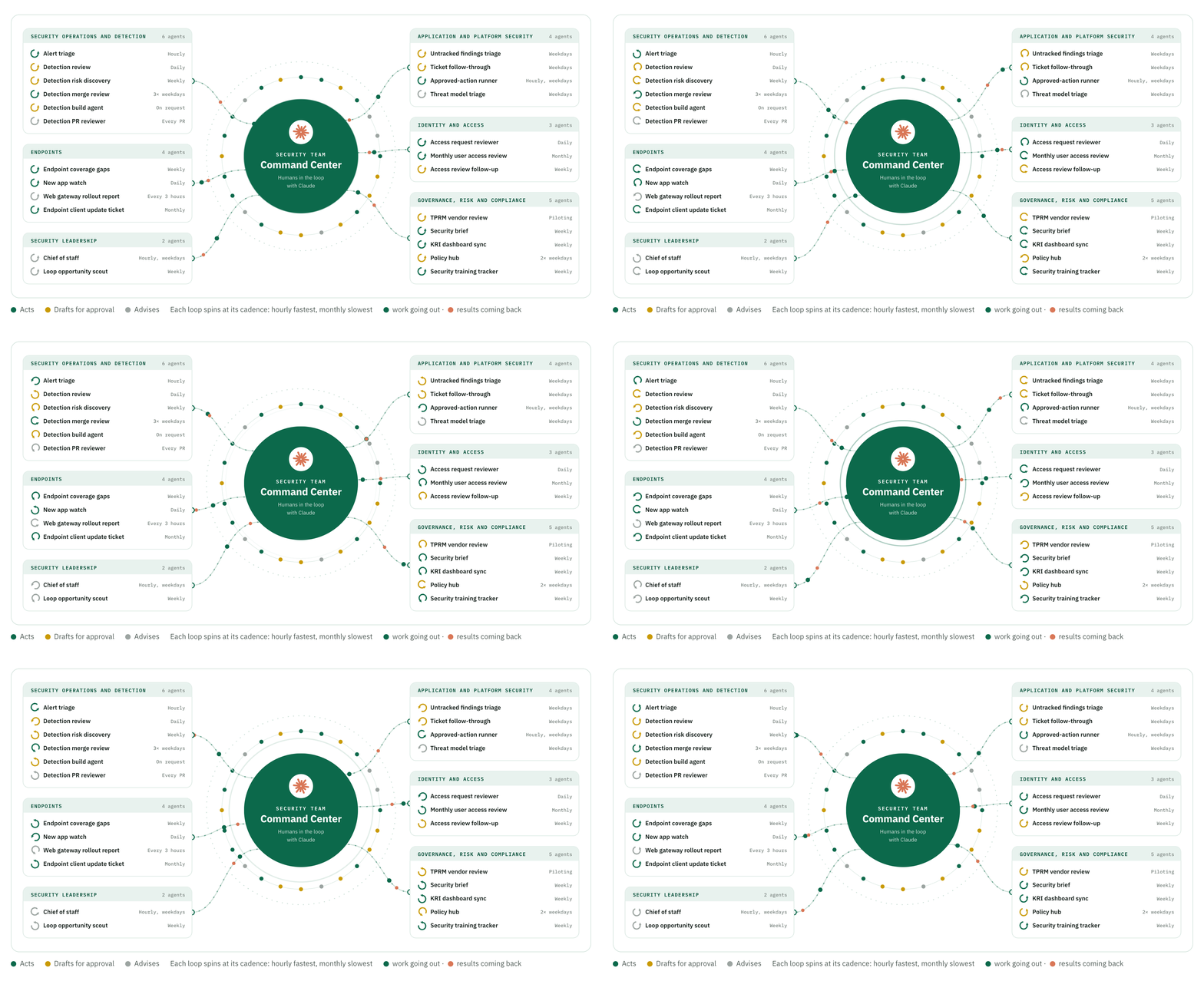
Here are the highlights:
- Detection engineering. I'll start with one I'm especially proud of, my detection engineering loop. For most of my career, "detection as code" was a conference-talk phrase I nodded along to, the kind of thing reserved for teams with a dedicated detection engineer and a tidy backlog of Sigma rules. In the AI paradigm it is insane how, as if by magic, I can now have that which I wanted then and so much more. On a weekly basis, I have a threat hunting agent that looks for risks in my environment that we lack meaningful detections around. This can be triggered manually, of course, in terms of my naming a risk I care about ("tell me if someone grabs a stolen cloud key and starts bulk-decrypting things in prod"). As I approve detection ideas, they get filed as issues in my code repo, and a detection engineering agent takes it from there to build. It goes into my SIEM and studies 30 days of our real logs to learn what normal looks like, writes the rules, replays them against that month to prove they won't bury me in noise, and opens a pull request. Every new rule starts in shadow mode, firing quietly into a dump-all firehose channel for a set amount of time before it's allowed anywhere near the pager. The detection engineering agent runs on a schedule to sort what it caught into "real" or "needs tuning" and drafts the fix, and a weekly pass even goes looking for gaps and suggests what I should be detecting next. After some confidence, they get promoted to the on-call schedule.
- Alert triage. On the flip side of building detections that make noise is actually living with them. I have an alert-triage agent that picks up anything landing in our security queue and does the first pass a SOC analyst would (or if you're lazy and time-crunched like me, wouldn't). It jumps into my SIEM, the host, IAM, productivity tools, cloud service provider, and more. Then it writes its work back onto the paging alert, work ticket, and chat channel: what it checked, the timeline it built, and its verdict. Given that even a healthy signal-to-noise ratio is noisy... this is amazingly huge. And of course, the feedback goes back into the detection pipeline itself as it reads the draft alerts in the firehose and triages them. I can't overstate how nice it has been to have this always-on teammate on my on-call schedule handling the context-heavy first pass an MSSP isn't positioned to do.
- GRC-land: vendor tiering. Entering more so corporate security-land, a good program is only as good as inventory and ability to prioritize (e.g., vendor/system tiering). With connectors to my GRC tool and IAM provider, my agent knows my TPRM standards and applies them by looking through our wiki, ticketing system, chat, etc. for context and then ranking them in our GRC tool all in one fell swoop. Metadata about the vendors (e.g., owner, sub-processor) is manipulate-able via MCP and the tedious work of combing through becomes effortless. Yes - there is manual review after the fact but I found this move and similar ones to be frankly pretty high fidelity using the latest models and having proper connectors in place. Running on a loop, my inventory is weekly being updated for new vendors, owners, tiering, etc. such that my other processes (e.g., TPRM) are pulling in from an accurate listing.
- AppSec and vulnerability management. My ASPM scans our code base and container repos, and even though they are pretty great (relative to other tools I've used) at auto closing false positives, the false positive rate sans a deep codebase scan is still so high that it is difficult to justify auto creation of tickets. I have a skill that catches every High or Critical finding before it becomes a bug ticket and answers questions the scanner by default doesn't: is it truly reachable? Is it truly exploitable? Where does it sit in our infrastructure? It comes back with a verdict (ticket it, downgrade it, or ignore it) with its reasoning attached and gets run on a daily routine. My setup is crude but essentially does the analytical work that previously only a dedicated appsec engineer could do. It truthfully has been less revolutionary than I wanted it to be since it just moved the bottleneck a few feet down the pipeline to the age old questions of "will upgrading this break everything?", "who's actually going to do it?". My agent can route the ticket to the right pod but it can't convince a product team to put a dependency upgrade ahead of a customer feature. As an aside, I see where the puck is going here and do see a world where vulnerability management is becoming a solved problem (maybe I'll eat my words) when enough compute/$$$ is pointed at the problem with deep codebase scanning that frontier models can do and the immediate handoff to a fix that has that same deep codebase understanding. I've got duct tape and bubblegum but ASPM vendor features are getting there already.
- Threat modeling. Threat modeling for a small security team is the ever elusive "would be great to do" thing that never is meaningfully done. I have an agent that scours for PRDs and User Stories that describe new system features and performs a STRIDE style threat model on the given thing along with a general risk assessment. My agent posts a comment on the item flagging considerations and any critical recommendations so that devs, and who are we kidding I mean the agents that read the ticket, will have security further prompted into the development. It'll flag me when something is big time and needs additional review but it's a long improvement from having to manually peruse these activities, sit in on product/eng meetings, or wait until a change board captures it (doubtful). The cherry on top is that an adjacent agent will track if associated PRs actually followed the guidance.
- Executive security reporting. In GRC land, I also have agents running routines that touch vendor security assessments, audit evidence collection, information security questionnaire completion, and my favorite, executive security reporting automation. I've got a monthly security brief going where I track a dozen or so metrics across my program (think MTTR for vuln management, phishing susceptibility, etc). At this point, about 60% of them are pulled automatically by API or MCP, the rest I go take some screenshots from different portals. What used to be half a day's work pulling together a really ugly slide deck (sorry to my old team members), I now pull this information at the speed of sound, pumped into a beautiful HTML page stored in git that is an interactive web page (internal site) that I share with my executive team. How do you communicate the good work you're doing? That's always a challenge. Having an agent do it, and do it beautifully, and in a way that feels sustainable is really a treat.
- Chief of Staff to the CISO. All of these gets pulled together by an agent of mine that runs every hour surfacing "human in the loop" decisions that I need to make and other things that need my attention (approvals, emails, ticket comments, etc.).
The above is just an illustration of my agent army, and truly every other day I create a new variant or make updates. Working centrally from my AI workbench is a huge shift from my old life and has been the biggest force multiplier I've ever experienced in my career. There are certainly many kinks to be ironed out and output isn't perfect, but that has always been the case! Some challenges still include non-human identity management, agent activity logging, attribution and accountability, and portability. Hosting agents in cloud environments versus locally versus sitting on top of middleware (e.g., a no-code automation platform) each carry their pros and cons, and I'm honestly not sure what the right answer is (or if one answer exists). Local agents, of course, lack some level of portability (and the ability to work when your laptop is shut lol), but cloud-based environments require remote access, additional spend, and a level of engineering that might make sense for a larger established team but be overkill for the small but mighty security org.
Ultimately, the difference now is that I am achieving a level of program detail that simply wasn't possible with resource and funding constraints. This is a completely made-up number, but I estimate 50x in productivity, accuracy, and completeness. Things that used to occupy 50% of my team members' days are now automated such that more value-add work can occur, like actually meeting with stakeholders and relationship building or actual risk reduction moving beyond the compliance bare minimum.
The snowball effect has triggered, and week by week I am seeing how capable our program and team members are becoming in wielding the tools properly. The tipping point for me a few months ago occurred with scheduled performance of these skill/action groupings (amorphous blob that I would define as an agent), making them goal-oriented and recursive (loosely what people are calling loops), and, most interestingly, bringing my AI into the brainstorming process. Asking questions to the agent that boil down to simply "how do you improve yourself?" or "how do I make this process more efficient?" goes a LONG way. I have lots of ideas for improvement, but it doesn't hurt to consult the 1-zillion-parameter LLM.
I'm excited to see where the coming weeks and months take me and my team on this journey with our agent army. The snowball effect implies exponential growth. If the AI vulnerability frenzy hasn't turned the world into a post-apocalyptic wasteland by then, perhaps by 2027 I'll have worked my way out of a job and will have regretted writing this post! In any case, I'm enjoying my stint as crab army commander.